

Design clinical trials with speed and rigor
Reach confident, evidence-backed trial design decisions earlier — before protocols are finalized.
Sample size, inclusion and exclusion criteria, endpoints, and comparators are still open, and governance approval is the gate. Unlearn simulates the study against your actual criteria, validates against precedent, and quantifies the design tradeoffs, so your team walks into governance with numbers instead of positions.
Two ways to design with more certainty: simulate the trial before you commit, and design it with digital twins so it needs fewer patients.
Simulate before you commit
Anchor assumptions to credible evidence
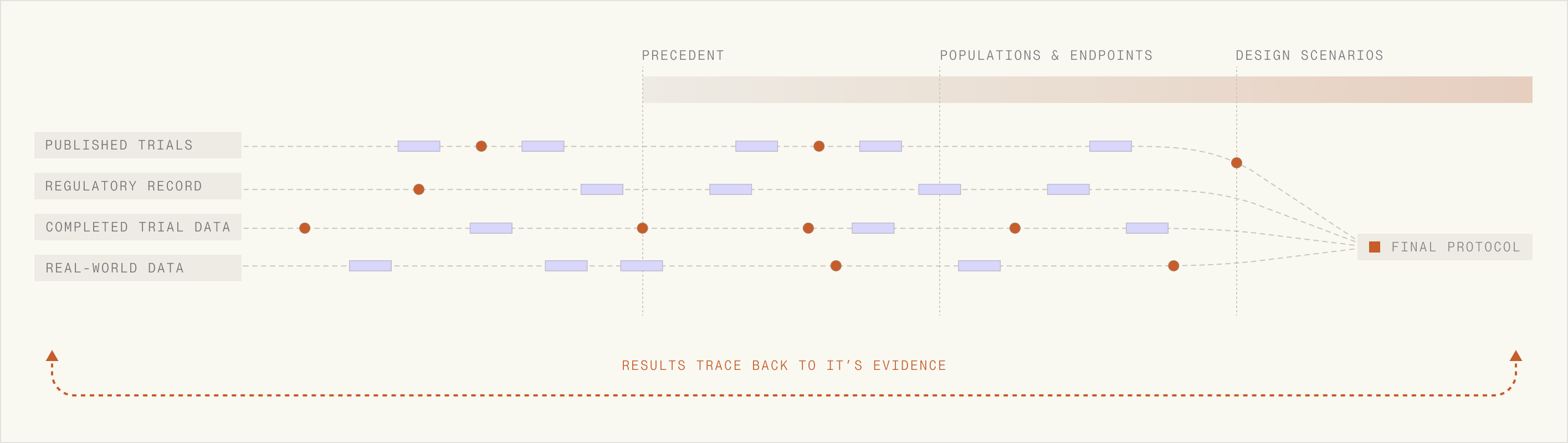
Trial Planning and Simulations puts precedent, data, and simulation to work on the trial you're actually designing. Prior trials in your indication are structured into sourced parameters in days, not weeks. Population characteristics, endpoint behavior, and comparator benchmarks are tested against the criteria on the table. Design scenarios are compared across endpoints, eligibility, and sample size on a population that reflects the trial being planned, before anything is locked.
Unlearn's Solution Scientists work alongside your team throughout. Any assumption can be questioned, and every claim stays traceable to its evidence, from first search through final protocol.
real-world impact
Designing an ALS Phase 1b/2a study with confidence
The sponsor’s Phase 1b/2a design was sized to detect slowing in neurofilament light (NfL). Scenario simulations showed the same signal could be observed with a 20% smaller sample, the reduction the sponsor locked into its final design. At roughly $250K per patient, the reduction translates into meaningful program-level savings.
proof points
real-world impact
Design with digital twins
Fewer patients, same power
Design trials with digital twins to reduce sample sizes while maintaining power, or boost power without adding patients. Validated across multiple Phase 2 and Phase 3 trials; qualified by EMA and aligned with FDA guidance.
proof points
When a concurrent placebo arm isn't possible, digital twins serve as an externally controlled arm (ECA), enabling credible treatment comparisons where randomization is not an option. Estimate treatment effects with greater rigor than standard external control approaches and strengthen high-stakes go/no-go decisions through improved statistical sensitivity.
power raised from adding digital twins
In an open-label ALS analysis presented with ProJenX, pairing 35 participants with digital twins raised power from 72% to 82% for detecting a 20% slowing on plasma neurofilament light.
Regulatory Acceptance
Unlearn's methods have been recognized and supported by both U.S. and European regulators. Our digital twins-based method was officially qualified by the European Medicines Agency for use in Phase 2 and 3 RCTs with continuous outcomes. The U.S. FDA provided positive feedback, supporting its use in covariate-adjusted analyses across clinical development. No other AI methodology in clinical trials carries that regulatory weight.
CHMP qualifies PROCOVA and that the proposed procedures could enable increases in power and/or decreases in sample size in phase 2 and 3 in clinical trials with continuous outcomes.
FDA recommends that sponsors adjust for covariates that are anticipated to be most strongly associated with the outcome of interest… the sample size and power calculations can be based on adjusted or unadjusted methods.


