

Unlearn in Alzheimer's disease
Alzheimer's trials fail far more often than they succeed — and every completed study holds evidence for the next one. Unlearn turns that evidence into a compounding advantage: each trial informs the next, decisions come earlier, and new therapies reach patients faster.
Digital twins power that advantage. They forecast each trial participant's expected progression and sharpen the analysis, increasing the likelihood of detecting a treatment effect if one exists.
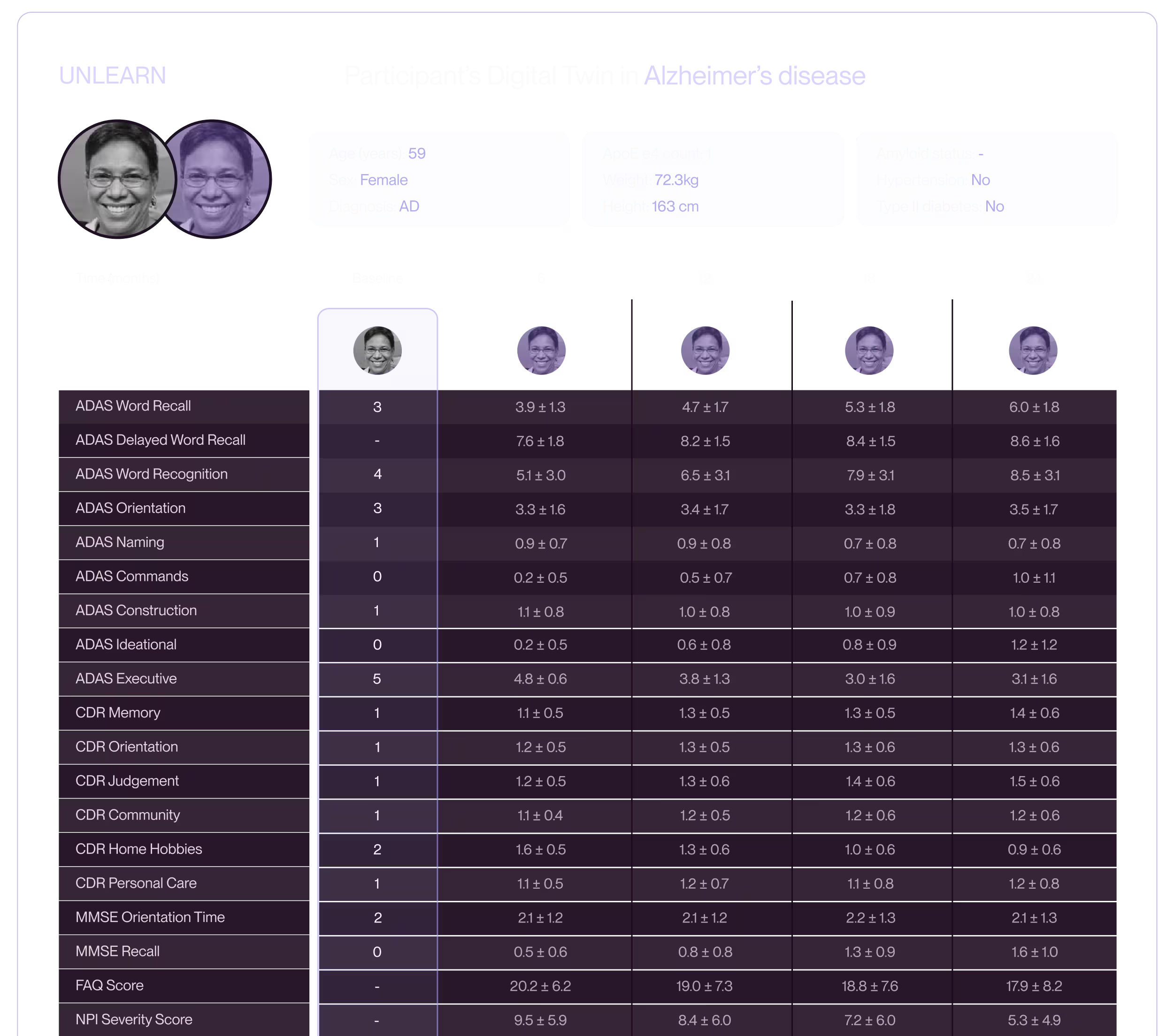
Unlearn's Digital Twin Generator for Alzheimer's disease is trained on data from more than 25,000 participants spanning cognitively normal through moderate Alzheimer's disease to generate comprehensive, longitudinal disease forecasts for each enrolled trial participant.
.png)

Key Numbers
Impact in AD
Get a clear answer from the patients you already enrolled
A study powered at 80% still misses a real treatment effect one time in five — and subgroup analyses fare worse. In a simulation of a Phase 3 trial in early AD, modeled on a completed registrational study, adding participants' digital twins to the analysis (PROCOVA) raised statistical power in the MCI subgroup across every endpoint — on CDR-SB, from 32% to 47%. With 248 MCI patients, the digital twin analysis achieved the same power as a conventional analysis would have with 396.
About this study
In this simulation study, participants meeting the inclusion and exclusion criteria of TRAILBLAZER-ALZ 2 (NCT04437511), the Phase 3 donanemab trial, were selected from Unlearn's harmonized database. A synthetic dataset of over 13,000 trajectories modeled disease progression across endpoints, with the treatment effect tuned to the trial's measured primary result.
Across 10,000 bootstrap samples of 650 patients per arm, the MCI subgroup (~19% of the population) was analyzed with and without digital twins as prognostic covariates (PROCOVA). Power increases ranged from 1 to 15 percentage points across iADRS, ADAS-Cog 13, ADCS-iADL, CDR-SB, and MMSE.
Shrink the control arm in the next Phase 3
In re-analyses of completed Phase 3 Alzheimer's trials from a top 5 global pharmaceutical company, incorporating participants' digital twins supported a 33% smaller control arm while maintaining power: fewer placebo patients, faster enrollment, and more participants on active treatment.
About this study
A top 5 global pharmaceutical company used digital twins in randomized, double-blind, placebo-controlled completed Phase 3 trials in mild-to-moderate AD and mild cognitive impairment to demonstrate the potential of participants' digital twins in reducing sample sizes or increasing study power using ADAS-Cog11 and CDR-SB clinical outcomes. Efficacy was assessed using ADAS-Cog11 score at 18 months.
APOE e4 allele carriers (NCT00575055); APOE e4 allele non-carriers (NCT00574132).
Turn a completed study into a smaller next trial
Once a study has read out, the next question is what the confirmatory trial should look like. In AbbVie's completed Phase 2 AWARE study in early Alzheimer's disease, incorporating participants' digital twins reduced the required sample size by 15%, or the control-arm size by 26%, with statistical power maintained, measuring change from baseline on CDR-SB at week 96.
About this study
AbbVie utilized Unlearn's digital twins in its completed Phase 2 AWARE study (NCT02880956), a randomized, double-blind, placebo-controlled trial in early AD, to demonstrate the potential of participants' digital twins in reducing sample sizes or increasing power. Efficacy was assessed using CDR-SB at Week 96 across different doses.
The trained AD-DTG was pre-specified before conducting the retrospective analyses. Prognostic scores derived from participants' digital twins were used to estimate treatment variance for the clinical outcomes, translating into sample size reductions or power increases without compromising Type-1 error control.
“This variance reduction (with digital twins) could have had a significant impact on the number of subjects we needed…and still preserved the same power…we would have had a faster enrollment, encourage(d) greater patient participation. And ultimately, that would have been cost saving and time saving.”
Ole Graff, Head of Neurodegeneration, Neuroscience Clinical Development, AbbVie · AD/PD 2025 Conference, Vienna
Watch the full presentation ↗Solutions
Every clinical trial is a chain of high-stakes decisions.
Unlearn can help at any point in your study. Digital twins, data, and AI strengthen each one, so study teams can commit with confidence, and evidence compounds from one decision to the next.
Sample size, eligibility criteria, endpoints, and comparators are still up for discussion, and governance approval is ultimately the gate before the study design can move forward. Unlearn simulates the study against your actual criteria, validates against precedent, and quantifies the design trade-offs, so your team walks into governance with data-driven numbers that support key study design decisions.
In Alzheimer's disease, that means testing your eligibility criteria against harmonized historical data, comparing designs across the endpoints you are considering, and pressure-testing the progression assumption behind the sample size, all before anything is locked in the protocol.
Build and compare trial-design scenarios to evaluate endpoints, eligibility criteria, sample size, and constraints, and to pressure-test sample size and PTS assumptions.
Add digital twins of participants to the statistical analysis plan (using PROCOVA, our EMA-qualified, FDA-supported method) to reduce sample sizes in randomized controlled trials while maintaining power, or boost power without adding new patients.
Design robust, efficient externally controlled and hybrid studies, whether randomization is not an option or a smaller control arm is the goal: anticipate the impact of the external comparator and select the eligibility criteria that give an open-label or single-arm study its best chance of a clear, interpretable readout. Digital twins can serve as individualized comparators on their own, be combined with a propensity model for added robustness, or strengthen a traditional historical control rather than replace it.
The protocol is locked. The analysis plan can still be optimized.
Every interim decision, whether to stop for efficacy, stop for futility, re-estimate the sample size, or revisit key design assumptions, rests on an interim estimate. Pre-specified digital twin analyses, added to the statistical analysis plan before unblinding, tighten that estimate without adding patients, and design scenarios can be re-run when new evidence emerges mid-study.
Add digital twins of participants to the statistical analysis plan (using PROCOVA, our EMA-qualified, FDA-supported method) before unblinding to raise power at interim looks and in subgroup analyses.
Re-run design scenarios against new evidence, whether a competitor readout, a new publication, or blinded data drifting from design assumptions, to confirm the current design holds or identify what to change.
Unlearn scientists generate digital twins from baseline data already collected, draft the pre-specified analysis for the SAP, and deliver the twin-adjusted analysis at interim and at readout.
The study has read out. The evidence is not finished.
Your completed study holds more evidence than the readout showed. Re-evaluating the data with regulatory-aligned methods separates expected disease progression from treatment effect, for a sharper estimate of the effect across primary and secondary endpoints.
Re-analyze the completed study against each participant's digital twin to separate expected disease progression from treatment effect, whether the study met its endpoint or missed it.
Read the result against evidence that did not exist when the trial was designed, including other studies that have since read out.
Carry what the study revealed into the next design: a validated view of disease progression, a better estimate of the effect, and a design that starts from what you now know.
Technology
Digital Twin Generators
Digital Twin Generators (DTGs) are machine learning models that produce individualized forecasts, called digital twins, of each trial participant's expected clinical outcomes under placebo or standard of care. These forecasts are generated using baseline data and include predicted values for item-level assessments, labs, vitals, and other clinical measures. DTGs are powered by Neural Boltzmann Machines, a proprietary machine learning architecture optimized for probabilistically modeling complex, multivariate, time-series data.
AD-DTG-4.2 is trained on data spanning preclinical and mild cognitive impairment through mild-to-moderate Alzheimer's disease, drawn from sources including the Alzheimer's Disease Neuroimaging Initiative (ADNI), the Critical Path for Alzheimer's Disease (CPAD), the National Alzheimer's Coordinating Center (NACC), the European Prevention of Alzheimer's Dementia study (EPAD), and the Knight Alzheimer's Disease Research Center, and is regularly updated with new endpoints and new data.
Regulatory Acceptance
Paving the regulatory path for AI in clinical trials
Unlearn's methods have been recognized and supported by both U.S. and European regulators. The European Medicines Agency officially qualified our digital twins-based method for use in Phase 2 and 3 trials with continuous outcomes. The U.S. FDA provided positive feedback, supporting its use in covariate-adjusted analyses across clinical development.
CHMP qualifies PROCOVA and that the proposed procedures could enable increases in power and/or decreases in sample size in phase 2 and 3 in clinical trials with continuous outcomes.
FDA recommends that sponsors adjust for covariates that are anticipated to be most strongly associated with the outcome of interest… the sample size and power calculations can be based on adjusted or unadjusted methods.
Evidence
Driving impact across clinical development
Explore how our partners are accelerating their clinical development programs with us.


