
The study has read out.
The evidence is not finished.
Gain a deeper understanding of your completed study by contextualizing the population, endpoints, and variability, and turn those insights into better-informed clinical development decisions.
.svg)
Re-evaluate and contextualize
Your completed study holds more evidence than the readout showed. Re-evaluating the data with regulatory-aligned methods separates expected disease progression from treatment effect, for a sharper estimate of the effect across primary and secondary endpoints.
A readout rarely answers only the question it was powered for. Effect sizes shift, subgroups behave unexpectedly, and endpoints move differently than the design assumed. Meanwhile, other studies read out, and their results change what yours needs to show. Re-analyzing against each participant's digital twin helps separate expected disease progression from treatment effect in the data you already hold, so an ambiguous result becomes interpretable, a positive one becomes better understood, and either can be read against evidence that didn't exist when the trial was designed. The same methods apply whether the study met its endpoint or missed it, and to historical trials across your programs, so what one study taught is available to the next.
Case Studies
Backed by collaborative research
These results come from retrospective analyses of completed trials, and from simulations built on the same methods: a clearer view of what actually happened, and a foundation for bringing just digital twins into the next study.
Digital twins can help turn borderline findings into clearer evidence. In a representative simulation, adding digital twins raised statistical power by roughly 7 percentage points—which, for a study powered at 80%, cuts the chance of missing a real effect by about a third. Across ALS, Alzheimer's, and Huntington's, that reduction can reach 40%.
sample-size-reduction
For a sponsor's completed open-label early-phase study in Huntington's disease, Unlearn generated a digital twin forecast for each participant, providing registration-grade evidence to estimate efficacy and contextualizing observed outcomes against expected disease progression. For a randomized confirmatory study, digital twins are estimated to enable 10–17% lower enrollment.
lower enrollment
Once a study has read out, the next question is what the confirmatory trial should look like. For a Huntington's disease registrational study with a top global pharmaceutical company, measuring change from baseline on cUHDRS, simulations incorporating participants' digital twins reduced required sample sizes by 17–29% and control-arm sizes by 24–44%, across 1:1 and 2:1 randomization at 24 and 36 months.
lower enrollment
control-arm-reduction
Re-analyzed with participants' digital twins, a completed Phase 3 ALS trial (NCT00349622) could have kept full power with 92 fewer participants, cutting trial costs about 18%, from ~$77M to ~$63M.
fewer participants
saved, from ~$77M to ~$63M
AbbVie utilized Unlearn's digital twins to their completed Phase 2 AWARE study (NCT02880956), a randomized, double-blind, placebo-controlled trial in early AD assessing CDR-SB at Week 96.
Result: a 17% sample-size reduction with 90% power maintained, without compromising Type-1 error control.
In Alzheimer's program planning, retrospective analyses across multiple Phase 2 and 3 AD trials project Phase 3 savings of ~$50M–$70M and 4–5+ months per program.
Phase 3 savings
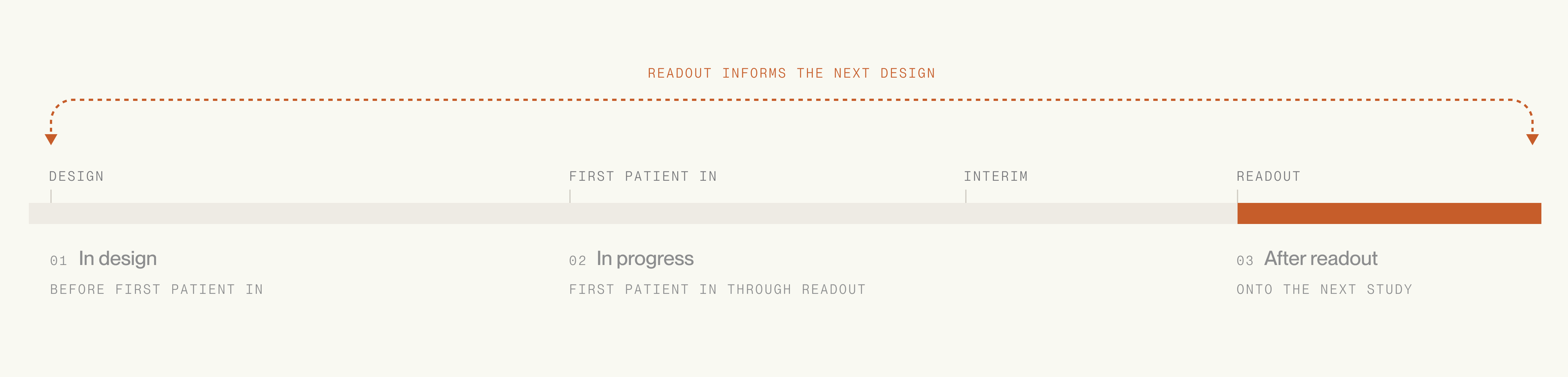
THE LIFECYCLE
Readout informs
the next design.
What this study revealed becomes evidence for the decision that follows readout, whether and how the program continues: a validated view of disease progression, a better estimate of the effect, and a design that starts from what you now know.