
Unlearn in Huntington's disease
Huntington's disease is clinically heterogeneous, with substantial variability in symptom presentation and rate of progression across individuals and stages of disease. That variability makes treatment effects hard to detect with traditional clinical endpoints over relatively short trial periods, and it makes the assumption every trial rests on harder to get right: how each participant would progress without the investigational treatment. That assumption is locked before the first participant is enrolled, so it has to be made from the beginning.
Digital twins address both problems. They forecast each participant's expected progression, and they reduce variability in the analysis, increasing the likelihood of detecting a treatment effect if one exists.
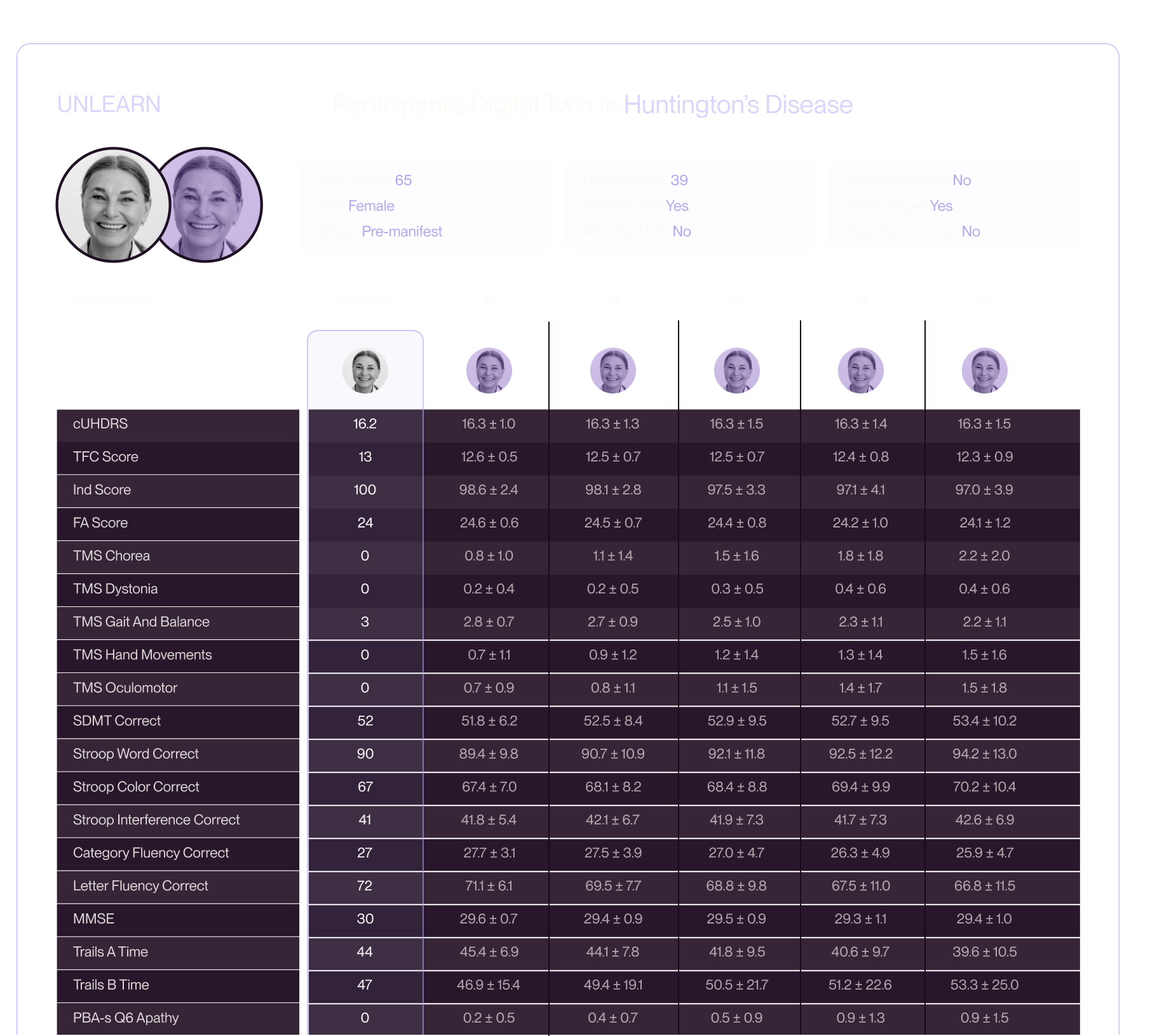
Unlearn's Digital Twin Generator for Huntington's disease, trained on data from more than 19,000 HD patients, forecasts each trial participant's expected clinical outcomes under placebo based on their baseline data. Those forecasts have been validated against the observed outcomes of completed trials, so the expected progression your study is designed and analyzed against has already been put to the test.
Key Numbers
Real-world impact in HD
Turning a borderline result into clearer evidence
A study powered at 80% still misses a real treatment effect one time in five. In planning a Phase 2/3 Huntington's study that will add participants' digital twins to the analysis (PROCOVA), we showed power rising by up to 8 percentage points. That cuts the chance of missing a real effect by up to 40%.
From a completed study to a smaller Huntington's registrational trial
Once a study has read out, the next question is what the confirmatory trial should look like. For a Huntington's disease registrational study with a top global pharmaceutical company, incorporating participants' digital twins reduced required sample sizes by up to 29% or control-arm sizes by up to 44% when measuring change from baseline on cUHDRS. On Total Functional Capacity (TFC) at 24 months, the corresponding sample size reduction is roughly 20%.
More robust external control arms for single-arm trials
In a randomized Huntington's disease trial of coenzyme Q10, we tested two external controls against the enrolled control arm: propensity score matching (PSM) and a digital twin for every participant. Digital twins more closely replicated the disease progression observed in the enrolled controls, reducing bias by up to 45% versus PSM, and lifted statistical power on Total Functional Capacity from 70% with PSM to 86%.
When matching is infeasible or additional evidence is needed to support a matched external control analysis, digital twins provide an alternative or complementary approach to strengthen confidence in the estimated treatment effect.
Solutions
Every clinical trial is a chain of high-stakes decisions.
Unlearn can help at any point in your study. Digital twins, data, and AI strengthen each one, so study teams can commit with confidence, and evidence compounds from one decision to the next.
Unlearn's HD model enables sponsors to make smarter design decisions.
Sample size, eligibility criteria, endpoints, and comparators are still up for discussion, and governance approval is ultimately the gate before the study design can move forward. Unlearn simulates the study against your actual criteria, validates against precedent, and quantifies the design trade-offs, so your team walks into governance with data-driven numbers that support key study design decisions.
In Huntington's, that means testing eligibility choices such as HD-ISS stage, CAP score, and functional capacity against harmonized historical data, comparing designs on cUHDRS, Total Motor Score, and Total Functional Capacity, and pressure-testing the progression assumption behind the sample size, all before anything is locked in the protocol.
Build and compare trial-design scenarios to evaluate endpoints, eligibility criteria, sample size, and constraints, and to pressure-test sample size and PTS assumptions.
Add digital twins of participants to the statistical analysis plan (using our EMA-qualified, FDA-supported method, PROCOVA) to reduce sample sizes in randomized controlled trials while maintaining power, or boost power without adding new patients.
Design robust, efficient externally controlled and hybrid studies, whether randomization is not an option or a smaller control arm is the goal: anticipate the impact of the external comparator and select the eligibility criteria that give an open-label or single-arm study its best chance of a clear, interpretable readout. Determine the appropriate primary approach (DTs or PSM) and use the other as a key sensitivity analysis.
The protocol is locked. The analysis plan can still be optimized.
Every interim decision, whether to stop for efficacy, stop for futility, re-estimate the sample size, or revisit key design assumptions, rests on an interim estimate. Pre-specified digital twin analyses, added to the statistical analysis plan before unblinding, tighten that estimate without adding patients, and design scenarios can be re-run when new evidence emerges mid-study.
Add digital twins of participants to the statistical analysis plan (using our EMA-qualified method, PROCOVA) before unblinding to raise power at interim looks and in subgroup analyses.
Re-run design scenarios against new evidence, whether a competitor readout, a new publication, or blinded data drifting from design assumptions, to confirm the current design holds or identify what to change.
Unlearn scientists generate digital twins from baseline data already collected, draft the pre-specified analysis for the SAP, and deliver the twin-adjusted analysis at interim and at readout.
The study has read out. The evidence is not finished.
Your completed study holds more evidence than the readout showed. Re-evaluating the data with regulatory-aligned methods separates expected disease progression from treatment effect, for a sharper estimate of the effect across primary and secondary endpoints. In a representative simulation, adding digital twins raised statistical power by roughly 7 percentage points, which, for a study powered at 80%, cuts the chance of missing a real effect by about a third. Across ALS, Alzheimer's, and Huntington's, that reduction can reach 40%, the equivalent of raising power from 80% to 88%.
Without a concurrent control group, the efficacy readout of an open-label or single-arm Huntington's study depends on how reliably expected disease progression reflects the trajectory participants would have followed in the absence of treatment.
lower chance of missing a real treatment effect, across ALS, Alzheimer's, and Huntington's.
Digital twins support that expectation with individualized, data-driven forecasts that can be tested. In a reanalysis of the completed HD 2CARE trial, the randomized control arm was treated as a single-arm study against digital twin comparators, where the true treatment effect is zero. The digital twin estimates came in close to zero, with absolute standardized bias of about 14% on average across the reanalysis and most confidence intervals covering zero.
“High-quality, longitudinal clinical data are essential to advancing disease-specific modeling in neurodegenerative disorders. We are grateful to the Enroll-HD participants and CHDI for enabling research that can help improve how Huntington's disease trials are designed and analyzed.”
Technology
Digital Twin Generators
Digital Twin Generators (DTGs) are machine learning models that produce individualized forecasts, called digital twins, of each trial participant's expected clinical outcomes under placebo. These forecasts are generated using baseline data and include predicted values for item-level assessments, labs, vitals, and other clinical measures. DTGs are powered by Neural Boltzmann Machines, a proprietary machine learning architecture optimized for probabilistically modeling complex, multivariate, clinical time-series data.
HD-DTG-2.1 features an updated model architecture and is trained on a dataset of over 19,000 participants, spanning pre-manifest through manifest Huntington's disease.
Training data sources: CHDI Foundation, including the Enroll-HD, PREDICT-HD, TRACK-HD, IMAGE-HD, and others. Our model is regularly updated to include new endpoints and new data including imaging endpoints.
Regulatory Acceptance
Paving the regulatory path for AI in clinical trials
Unlearn's methods have been recognized and supported by both U.S. and European regulators. The European Medicines Agency officially qualified our digital twins-based method for use in Phase 2 and 3 trials with continuous outcomes. The U.S. FDA provided positive feedback, supporting its use in covariate-adjusted analyses across clinical development.
CHMP qualifies PROCOVA and that the proposed procedures could enable increases in power and/or decreases in sample size in phase 2 and 3 in clinical trials with continuous outcomes.
FDA recommends that sponsors adjust for covariates that are anticipated to be most strongly associated with the outcome of interest...it may be useful to use previous studies to select prognostic covariates or form prognostic indices.


